

Although renewables provide 30% of Queensland’s contribution to the NEM, the stability of its supply depends on the state’s fleet of thermal (coal and gas) power stations to provide firming capacity.
As renewable penetration continues to increase, Queensland needs more firming generation. To support this, the Queensland Government has introduced the $1.6 billion Electricity Maintenance Guarantee, a component of the Queensland Energy Roadmap 2025 to support government-owned corporation (GOC) power stations safe, reliable, and running well for longer.
This policy is creating a strong pipeline of refurbishment, upgrade, and repowering works that rely heavily on specialised engineering capability.
How the Electricity Maintenance Guarantee supports continued gas operation
Gas fired-generation remains central to power reliability because it can start quickly, respond to sudden changes in demand and support the system as renewables are being built or their output fluctuates.
But gas turbines are complex machines with thousands of moving parts and need regular maintenance. If not, they can break down, cause widespread blackouts, contribute to electricity price spikes, or even suffer major failures.
Investment under the Energy Maintenance Guarantee will help cover expensive major repairs, part replacements, safety checks, keep gas assets healthy, and performance upgrades without having to worry about whether they will have enough funds.
The government is also planning to add 400MW of gas generation to the state’s assets, and expects gas demand to increase to 8.3GW by 2035.
What refurbishment and life‑extension programs mean for performance
Queensland Treasurer and Minister for Energy David Janetzki said the plan “balances affordability, reliability and long-term sustainability,” adding that it is “based on economics and engineering, not ideology.”
The state has extended the operating life of its government‑owned coal fleet until at least 2046. The longer lifespans will call for significant refurbishment and investment to keep them operating safely and reliably.
Refurbishment and life‑extension programs improve performance by:
- replacing worn parts
- upgrading components
- upgrading control systems
- improving ramp rates
- preparing older gas and coal stations
- identifying aging risks
- improving safety systems
- setting up flexible operation required in a renewable-heavy system
- meeting the new government‑mandated safety and performance KPIs.
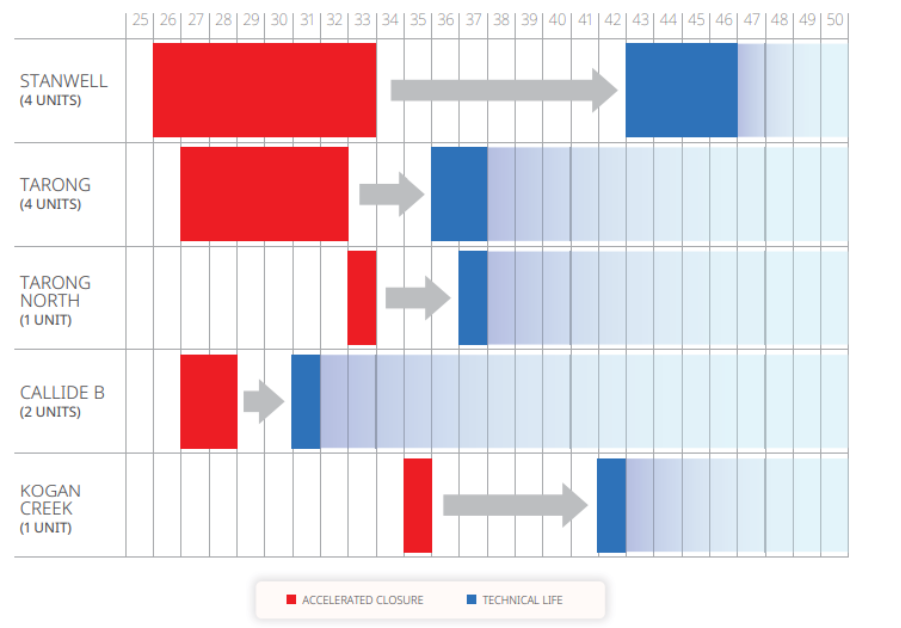
The table below from the Energy Council shows the previous and updated closure dates of Queensland’s new coal-fired power plants backed by the $1.6 billion Power Maintenance Guarantee, which improves the technical condition and overall performance of the assets.
Opportunities for hybrid and renewable integration
The Roadmap encourages combining thermal assets with renewable generation and storage technologies to transition toward a cleaner electricity system while maintaining reliability. For example, co-locating a new facility like a battery energy storage systems (BESS), on the site of an existing thermal power station reduces costs and a lot of approvals barriers.
Why long-term asset stewards need engineers with deep turbine history knowledge
Asset owners face a more complex operational environment during this renewable integration and the hybridisation opportunities.
Engineers who know the history of Queensland’s gas turbine operations can design refurbishment scopes and life‑extension programs that actually match the turbine’s true condition, rather than relying on generic assumptions.
Without this historical knowledge, deep technical background, and engineering risk management, upgrades may miss hidden risks or fail to prepare the turbine for future demands, especially if these plants need to run for another 10 to 20 years.
If you’re preparing a refurbishment, repowering or life extension program, engage Arche as your expert Owner’s Engineer. Our experience in gas turbine asset management ensures your upgrade delivers reliability, efficiency and future proofed performance.