
The FIFA World Cup is one of the biggest and most complex sporting events in the world, with a huge energy footprint from stadium operations to global travel, logistics, and broadcasting. With such high energy use, social expectations around sustainability are higher too. FIFA has responded by branding World Cups as carbon neutral, supported by footprint assessments and carbon offsets.
Why FIFA World Cups generate large carbon footprints
FIFA World Cups have a big carbon footprint mainly because they are huge, fast-paced events held in a short timeframe that require major energy use from stadiums, along with massive global travel, facilities, and logistics that are hard to decarbonise quickly.
To give an idea of the scale, FIFA reported that the FIFA World Cup Qatar 2022 produced about 3.81 million tonnes of CO₂ emissions from the preparation, the main events, and its post-event activities.
Most of that, or around 94.7% of the carbon footprint, came from stadium, accommodation, ground travel, accommodation, and logistics. The rest came from food, energy supply, materials, merch, waste, and water. Temporary setups for broadcasting, security, and power add even more.
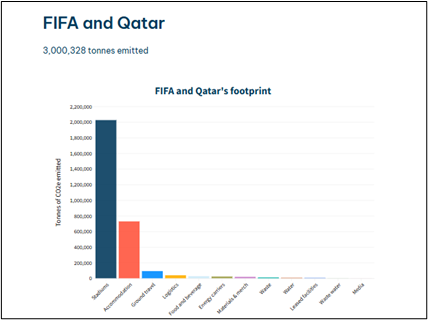
Source: theecoexperts
Because of this, a lot of emissions are hard to fully eliminate just through better stadium design or operations. That’s why organisers often rely on carbon offsets to deal with what’s left, and to support carbon neutral or net-emissions claims.
What carbon neutral and carbon offsets mean for the World Cup
Carbon neutral means the total emissions from the event are measured and then balanced out with offsets so the net impact can be reported as zero. In practice, organisers first calculate emissions from things like stadium, construction, travel, accommodation, and event operations.
Carbon offsets are generated by completely separate activities, like renewable energy or reforestation, that reduce or remove emissions. Organisers like FIFA can balance their carbon footprint by buying offsets.
Future tournament planning for net zero
Following criticism of its past claims of carbon neutrality, FIFA launched its Climate Strategy at the UN Climate Change Conference (COP26) in 2021.
The strategy commits to reducing greenhouse gas emissions by 50% by 2030 and reaching net zero by 2040.
Carbon neutrality as a tool for understanding impact
Enormous, complex events FIFA World Cups highlight the value and the limitations of carbon-neutral frameworks for large-scale events. While it offers a structured way to measure emissions and address remaining impacts through offsets, offsets do not eliminate emissions or the need for checks and balances.
For organisations delivering complex, infrastructure-heavy projects, carbon-neutral claims are best seen as a starting point, not a final outcome. Transparent reporting, clear reduction strategies, and credible offset use are essential for meaningful decision-making.
Arche supports this by delivering independent, engineering-led technical advice across renewable energy, transport, and major infrastructure projects, helping investors, developers, and government agencies understand emissions, assess mitigation pathways, and communicate sustainability outcomes.