
Unless you live under a rock, you will have noticed recently that Australia is sensitive to disruptions in its long fuel supply chain.
While we are blessed with plenty of resources, we rely on imported liquid fuels to produce food, to provide long-distance transport and to defend ourselves.
Providing strategic energy capacity is not the same as providing the most economical mix of energy sources; therefore, some of these solutions are not economical when viewed through the lens of an investment committee. Likewise with emissions reductions, some of these solutions will not contribute to emissions reductions (but many will). In this blog, I am viewing the solutions through the lens of strategic national capability (i.e. how do we supply the liquid fuels that we need to feed, move and defend ourselves during times of geopolitical crisis).
Here are six ways Australia can reduce its dependency on imported liquid fuels:
1. Expand domestic fuel refining capacity
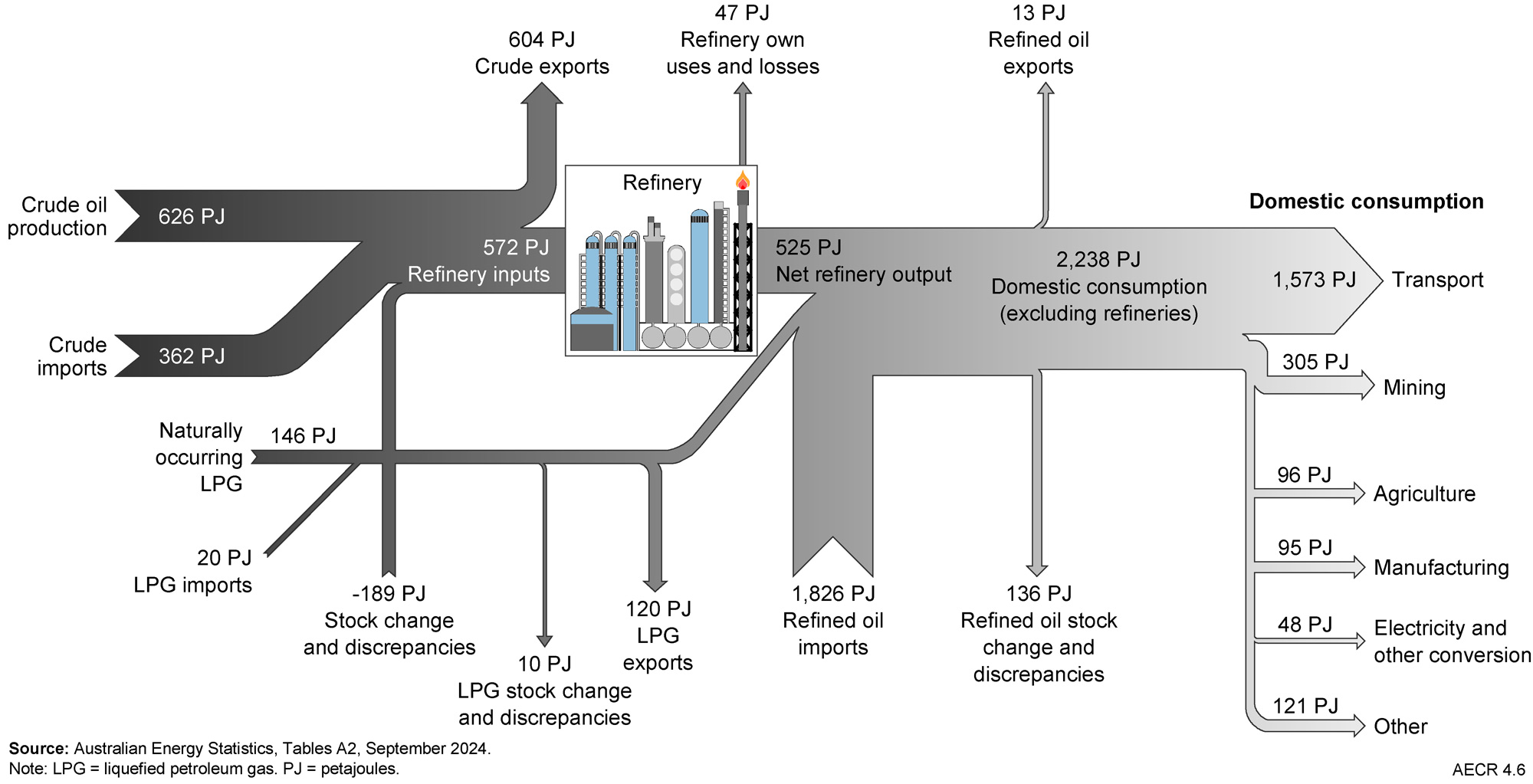
Making more liquid fuel products in Australia, means we are less reliant on imported refined products. Sure, we still need to source crude; however, having the refining capacity here in Australia means that we have more choices (we can import crude, or we can import refined products). In 2022-23 we refined 525 PJ of our 2,238 PJ of domestic consumption (i.e. 23%)[1].
2. Explore and develop domestic reserves
Australia still holds significant (100,255PJ[2]) demonstrated oil reserves (2C); however, only 7,551 PJ is proven and probable (2P). Converting 2C to 2P occurs through exploration, field development (and an increase in the value of oil). Our 2C reserves is around 50 years of 2022-23 domestic consumption, so there is an energy sovereignty dividend to be made through investment in our domestic oil projects.
3. Produce liquid fuels from coal, gas and waste
Australia has substantial (and geographically diverse) reserves of coal, gas and waste. Coal, natural gas, biomass and most wastes (anything containing carbon and/or hydrogen) can all be converted into syngas. Syngas can then be converted into longer chain hydrocarbons using the Fisher-Tropsch process.
My rough calculations indicate that we exported around 4,000 PJ of coal in 2025, therefore an ability to convert some of this into liquid fuels would contribute substantially to our energy sovereignty.
In my opinion developing a small scale commercial plant (possibly operating on waste) in order to develop the skills and knowledge base would be a good investment in our national strategic capability.
4. Reduce dependence through electrification or use of CNG/LNG
If you have just brought an EV, you would be laughing all the way to the bank with current fuel prices. If your family is like mine, I would suggest that most of our driving could be done with an EV (and the last 1-5% could be done with a plug in hybrid). It’s pretty obvious, more use of electricity for transportation means less imported refined product.
Use of compressed natural gas (CNG) or liquified natural gas (LNG) in trucks, trains and other vehicles allows us to use a fuel source (natural gas) that is produced locally and is conveyed (mostly) underground.
5. Invest in domestic e-fuel production
Methane can be produced from the methanation of carbon dioxide with hydrogen (the Sabatier Reaction). We produce plenty of carbon dioxide at our power stations and elsewhere, hydrogen can be readily electrolyzed from water.
Electricity for electrolysis can be produced from our reserves of coal, gas, wind, solar or uranium. Fisher Tropsch (see point 3 above) can then be used to produce the longer chain hydrocarbons required for liquid fuels.
Again, developing a small scale commercial plant gives us the know how to construct larger scale plant in the future if and when required (an investment in strategic intellectual capability).
6. Use more ethanol and biodiesel
Brazil’s current mandate is 30% ethanol for petrol engines and 15% biodiesel[3]. Flex fuel vehicles can use, up to, 85% ethanol[4].
Australia can produce ethanol from a variety of feedstocks including sugar cane, corn and sorghum. Biodiesel can be produced from vegetable oils, animal fats and used cooking oils. These feedstocks are all produced here in Australia.
Final thoughts
Australia can do a lot to reduce its reliance on imported refined products and imported crude and this will improve our resilience in times of war. To get there, we need to develop the projects, so that we can learn the lessons required to scale production. We also should consider our engineering capability to be a strategic national asset and aim to develop the know how that we will need to scale these technologies.
Countries with short supply chains, strong industrial output and skilled engineering workforces are more resilient in times of crisis. In my view there is a significant strategic advantage in Australia becoming more resilient with respect to our ability to produce liquid fuels.
References:
- [1] Australia’s Energy Commodity Resources 2025 — Oil Figure 4.6 accessed 19 March 2026.
- [2] Australia’s Energy Commodity Resources 2025 — Oil accessed 19 March 2026.
- [3] Brazil to boost biofuel mandates to E30, B15 accessed 19 March 2026
- [4] A Guide to Ethanol Gas Blends at the Pump accessed 19 March 2026