
A year ago, Bloomberg NEF (BNEF) reported the largest annual drop in battery prices since 2017. Turnkey energy storage system prices fell by around 40%, dropping to US$165/kWh in 2024, compared to 2023 levels. This significant drop was made possible by a combination of factors: lower metal and component prices, excess cell manufacturing capacity, and advances in technology.
Meanwhile, this important decline in battery storage costs is a positive indicator of substantial growth prospects for battery energy storage systems (BESS) in all global markets, including Australia’s, where even more businesses in multiple sectors will stand to benefit from cheaper and more reliable energy storage solutions.
The cost of battery storage is dropping fast
In December 2024, BNEF reported a historic 40% year-on-year drop in the cost of BESS. The average price of a turnkey energy storage system fell to about US$165 per kilowatt-hour. It’s marking the largest reduction since the Battery Storage System Cost Survey began in 2017.
Additionally, lithium-ion battery pack prices saw a significant 20% drop from 2023, reaching a record low of $115 per kilowatt-hour. Looking ahead, BNEF forecasts further reductions with pack prices expected to fall by $3/kWh in 2025, continuing the trend of cost declines.
Battery storage costs hit a record low in 2025
Source: BloombergNEF
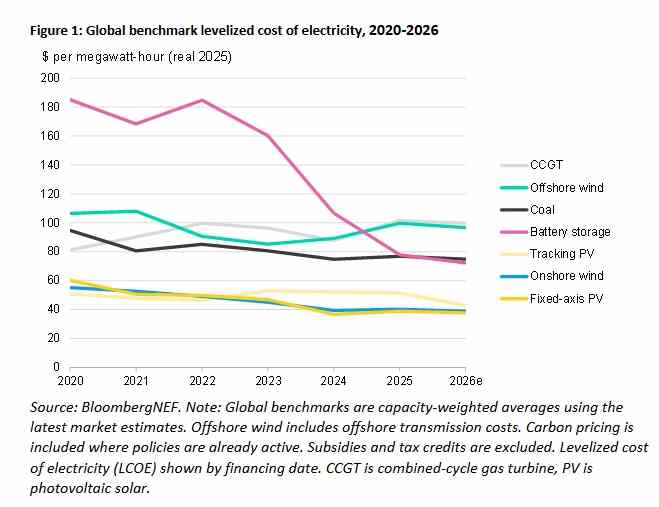
BloombergNEF’s Levelized Cost of Electricity 2026 report shows that battery storage project costs are set to plummet to a new low by 2025, even as most other clean energy technologies become more expensive.
The global benchmark cost for a four-hour battery project fell 27% year-on-year to $78 per megawatt-hour (MWh) in 2025. This is the lowest number in history since BNEF began tracking costs in 2009.
The sharp drop’s been driven by more competition between manufacturers and better system design. Lower battery costs are also driving the buildout of co-located renewable projects. By 2025 alone, developers are adding 87GW of combined solar and storage, delivering power at an average price of $57/MWh.
BloombergNEF predicts that battery storage costs will continue to decline, driven by continued innovation and competitive pressures. By 2035, the levelised cost of electricity (LCOE) for battery storage is expected to decline by a further 25%, to strengthen storage’s role in supporting renewable energy integration.
Year-on-year cost changes
Historical prices for turnkey energy storage systems (2017–2024)
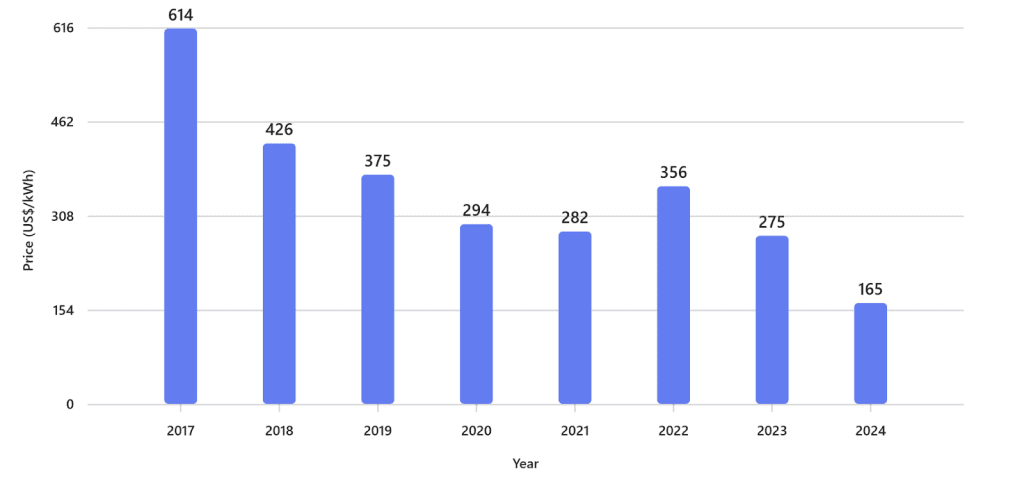
Quoting from BNEF, via Energy-Storage.news, the trend reflects falling material costs, manufacturing overcapacity, and technology improvements, making BESS more competitive globally. Indeed, this sharp reduction signals accelerated adoption of energy storage worldwide, including in Australia, where lower costs are driving major investments in grid-scale projects.
Lithium-ion Battery Pack and Cell Prices (2013–2024)
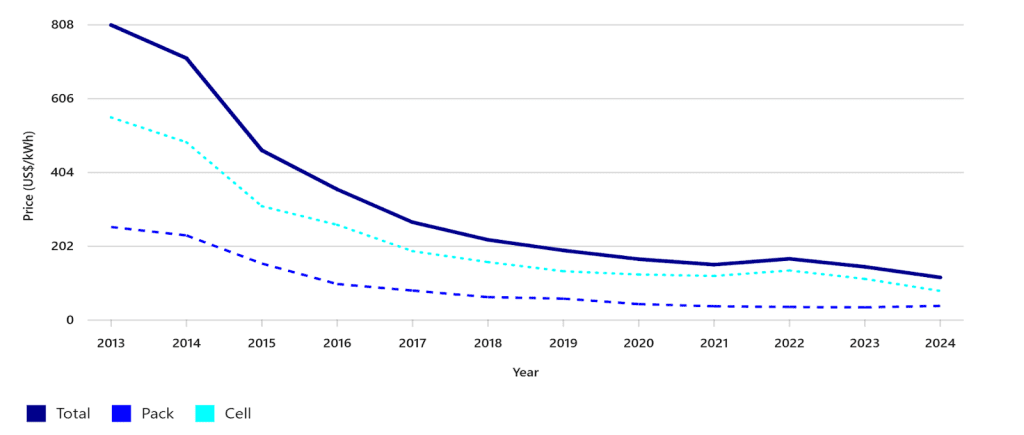
Based on BNEF, via Energy-Storage.news, this decline is driven by lower raw material costs, adoption of LFP chemistries, and improved manufacturing efficiency. BNEF also expects further reductions in the coming years, reinforcing the downward trend that makes both EV and stationary storage markets more cost-effective.
The factors driving this reduction
1. Manufacturing overcapacity
In response to anticipated high demand for batteries in both the electric vehicle (EV) and stationary storage markets, battery manufacturers have aggressively expanded production capacity over the past two years.
However, the reality of demand has been more mixed. While EV sales grew slower than previous years, the stationary storage market has experienced significant growth. It’s particularly in China, where fierce competition between cell and system providers has intensified.
Right now, global battery-cell production has hit 3.1 terawatt-hours. That’s more than double what the world needed for lithium-ion batteries in 2024. With so much extra supply, prices are dropping fast as manufacturers fight to win customers.
Evelina Stoikou, the head of BNEF’s battery technology team, comments:
The price drop for battery cells this year was greater compared to that seen in battery metal prices, indicating that margins for battery manufacturers are being squeezed. Smaller manufacturers face particular pressure to lower cell prices to fight for market share.
2. Lithium-Ion battery pack prices
Over the past year, Lithium-ion battery pack costs have dropped by 20%, with the average price in 2024 sitting at US$115 per kilowatt-hour. The combination of lower raw material costs and improvements in manufacturing efficiency has made battery storage cheaper than ever before.
As Yayoi Sekine, head of energy storage at BNEF, explains:
One thing we’re watching is how new tariffs on finished battery products may lead to distortionary pricing dynamics and slow end-product demand. Regardless, higher adoption of LFP chemistries, continued market competition, and improvements in technology, material processing, and manufacturing will exert downward pressure on battery prices.
3. Technology improvement
Advancements in battery technology, such as the wider adoption of lithium-iron-phosphate (LFP) chemistries and the use of larger cell sizes, have improved cost efficiency and extended battery life, thereby helping to drive price reductions.
The adoption of lower-cost LFP chemistries, combined with ongoing market competition and advancements in materials processing and manufacturing techniques, has helped drive down battery costs.
Also, BNEF anticipates further price declines as research and development (R&D) continues, and next-generation technologies are implemented.
What this means for Australian businesses
The battery price drop signals positive growth for BESS markets globally, also in Australia. In Q1 2025, the country saw an impressive AUD 2.4 billion invested in six major BESS projects, adding 1.5GW of new storage capacity. This marks the second-highest quarterly investment on record.
Moreover, according to Expert Market Research, the Australian energy storage market is projected to grow from 6.93GW in 2024 to 40.81GW by 2034, with a compound annual growth rate (CAGR) of 19.4%.
With the decrease in battery prices, this is set to benefit businesses and industries by making BESS solutions more affordable, enabling them to adopt energy storage systems that enhance energy efficiency, lower operational costs, and provide resilience in an increasingly renewable-powered future.
Increased affordability
The substantial decrease in BESS costs makes energy storage in Australia more accessible across various sectors, from residential to industrial applications and for a wider range of applications. It also lowers the upfront investment required, so Australian businesses can invest in energy solutions that were previously cost-prohibitive.
Improved return on investment
Lower BESS capital costs improve financial viability by shortening payback periods and enhancing returns. As battery prices decline, businesses benefit from greater savings on energy bills and more predictable energy costs, as well as increasing the attractiveness of investing in storage paired with renewables.
A report by Shoalhaven Solar states the federal Government’s Cheaper Home Batteries Program, which provides a 30% rebate for battery installations, provides a significant payback period reduction for solar and battery systems. This program provides a more intelligent investment of solar with battery storage for homes and businesses.
Support for renewable integration
The Australian Renewable Energy Agency (ARENA) notes that BESS, and especially the coupling of BESS with renewable energy generation, is a pragmatic way to provide grid stability. By charging during off peak periods, and discharging during peak periods, BESS helps provide a reliable and consistent energy supply for society. This practice aligns with Australia’s National Battery Strategy, which aims to improve the renewable energy integration necessary for Australia’s 2035 goals of 82% renewable energy.
Due to recent decreases in battery costs, this commitment becomes a realistic opportunity. Lowered costs of BESS utilities’ price point means investment in energy storage is more accessible to both businesses and households, and it will further expedite the energy transition toward a sustainable energy future. The pricing drop will also help ensure that energy storage supports the transition toward a cleaner, more resilient, and durable energy system in Australia.
Investments in energy storage, whether as a BESS utility or as part of an essential peak shaving investment with battery backup or integrated with solar, can help energy resilience, energy efficiency and operational costs.
Partnerships with established and trusted BESS solutions consultants will allow companies to engage with an evolving BESS market, maximise warranty potential, and invest in a more sustainable and reliable energy system in Australia.
Arche Energy is passionate about supporting BESS projects
So much so that we created BESS Auto™, an automation tool that creates BESS layouts in seconds. Watch our demo video for a peek into how it works.
See our battery energy power solutions page for more information about what our team can deliver.
Click the Enquire Now button to set up a call or coffee with one of our people to learn how Arche’s experience can help turn these opportunities into practical, investment-ready projects.