
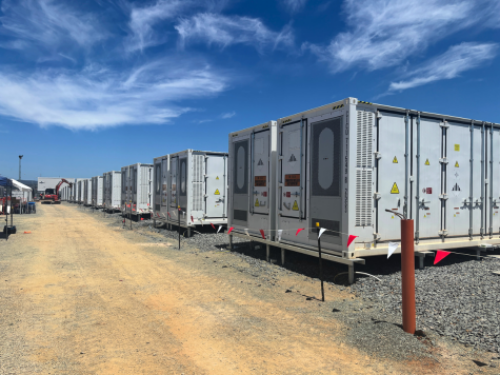
In March 2025, Energy Storage Summit Australia reported the possible explosive growth of large-scale battery energy storage systems (BESS) in the future of Australia’s National Electricity Market (NEM). It is expected that, as traditional generators retire, energy storage in Australia will account for 65% of on-demand capacity by 2035 and 75% by 2050.
“We’re working on some very large battery projects — gigawatt-scale,” says our CEO Andrew Murdoch.
“These projects harvest solar energy generated during the middle of the day, store it and then put it back onto the grid in the evening.”
This is how BESS is becoming the foundation for a reliable power supply.
Massive expansion of BESS capacity in the NEM
The growth in BESS projects means more than short-term trends. It illustrates a long-term shift towards a cleaner, more resilient and decentralised energy future for Australia.
How is growing battery energy storage in the NEM driving market growth?
- The NEM’s total energy storage capacity is expected to reach up to 38GW by 2035, compared to the current 5GW, according to the AEMO’s Step Change design.
- The shutdown of generating capacity indicates that energy storage is expected to grow to approximately 65% of distributed capacity by 2035 and increase to 75% by 2050.
- In early 2025, approximately A$2.4 billion (US$1.5 billion) was committed to large-scale BESS, the second-largest quarterly total after A$2.8 billion in late 2023.
- Six new major storage projects will add 1.5GW of power capacity and 5GWh of storage.
Storage capacity installed on the NEM is on track to double again by the end of 2026. If all projects are implemented as planned, operational BESS could reach about seven times today’s level (16.8GW of grid-scale storage) by 2027.
Market trends behind Australia’s battery storage surge
Investor confidence in battery energy storage is rising rapidly, and there are good reasons for it. The ongoing fluctuating electricity prices, rapid growth in renewables and the federal government providing strong support for storage are sending capital into battery storage. These factors together reduce risks and make batteries more of a practical, scalable alternative to support traditional generation, rather than just a small add on.
The technology mix is also evolving and the maturing of energy storage represents a step change in improved energy storage for greater grid flexibility and support the progress towards a reliable renewable future for Australia.
Projects are becoming much larger and the market’s appetite for greater than 500MW projects is now common. Numbers are moving from 1- to 2-hour systems to 4-hour systems and 8-hour systems are expected to be in place by 2027. The ability to storage energy for longer allows operators to shift more solar energy into the evening peak and balance wind output, and provide deeper grid service.
This momentum is not limited by region. New capacity is being rolled out across the NEM in central-west New South Wales, South Australia, Queensland, and Greater Melbourne. That spread reflects different local needs, available connections, and growing acceptance of batteries as core grid assets.
Underscoring the market’s broad appeal and strategic importance in Australia’s energy future, Andrew explains:
The combination of increasing wholesale electricity costs and substantial increases in network charges, incentivises homes and businesses with access to roof space to provide their own power. So, it makes sense that smart fund managers are pursuing opportunities to invest in decentralised systems.

What’s next for battery storage in Australia?
As Australia’s energy landscape evolves, the next wave of battery storage will likely focus on:
- scaling flexibility
- enhancing efficiency
- integrating emerging technologies such as vehicle-to-grid (V2G), advanced AI optimisation, and hybrid renewable-storage projects.
These developments will facilitate grid-scale assets as well as commercial, industrial and residential systems. As Andrew said on the Economics Explored podcast in 2023:
I think we’ll see a lot of batteries at an industry level as well. For example, a remote mine that’s supplied by a long, skinny transmission line that doesn’t quite have the capacity to power the mine. So the mine will put a battery in, trickle charge the battery during the day, and then use that battery to cover its peak demands that are too much for its transmission line.
The expanding digital platforms and clearer regulations will allow for a less centralised, more participatory energy market.
For Australian businesses, this creates the opportunity for more suitable storage that aligns with specific operational and energy sustainability goals. Early adopters can benefit from using real-time energy management to reduce demand charges, improve resilience to price shocks and potentially unlock value to sell grid services, also participate in virtual power facilities.
To adapt to BESS solutions, start by partnering with an Australian energy storage consultant to map the best pathway to value. Click the Enquire Now button on this page to grab a quick chat or coffee with our team and see how Arche can help you make the most of Australia’s battery storage boom.
Arche Energy is passionate about supporting BESS projects
So much so that we created BESS Auto™, an automation tool that creates BESS layouts in seconds. Watch our demo video for a peek into how it works.
Click the Enquire Now button to set up a call or coffee with one of our people to learn how Arche’s experience can help turn these opportunities into practical, investment-ready projects.